Skincare ad examples: read the image and the claim
Look at how the ad shows the product and how it's used. Then check whether the words promise more than the image can show.
Real ads, with the observations beside them
Reviewed references: whole images and 6-second silent video snippets.
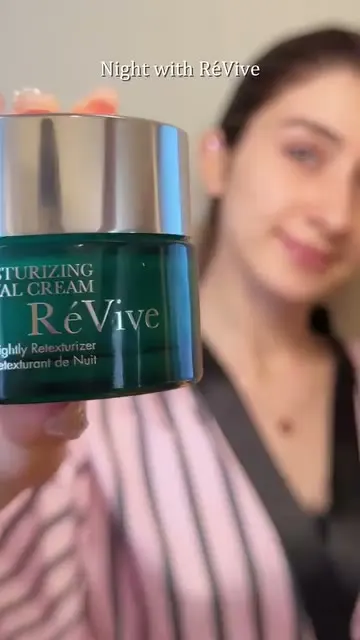
The product in the foreground
- The product is shown close to the camera and beside the person.
- Use a close-up when you need to show the label or a detail.
- Plan both views so the editor has a choice.
Read the notes
In this 6-second ReVive snippet, a product moves between a close view and a view beside the person. Later close-ups return attention to the product.
What to look for: Is the reference useful for product recognition or for an application demonstration?
Try this: Try a close-up that lets people see the product, then pull back to show it beside the person. Use the full source if you need to study the spoken message.
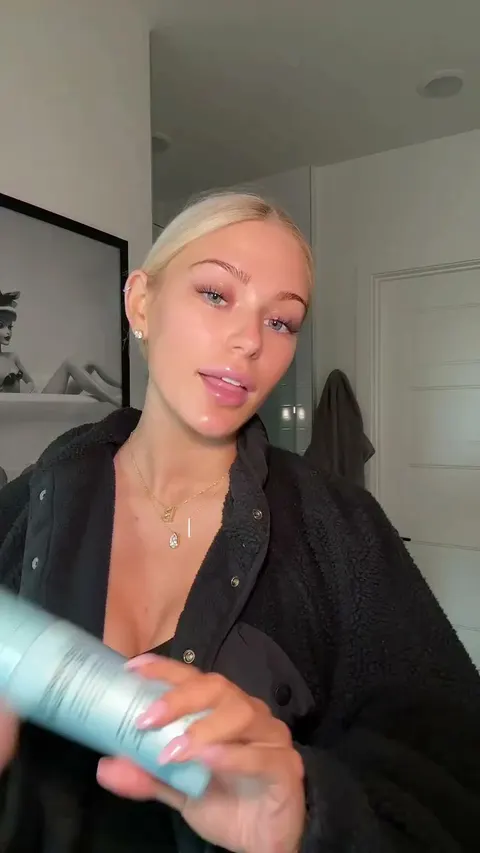
A person bringing the product closer
- The person brings the product closer to the camera.
- Notice when the product becomes easy to see.
- Ask for a clear close-up of your own product.
Read the notes
This 6-second INNBeauty snippet shows a creator gesturing with a product and bringing it near the camera. The face and product share the composition.
What to look for: How much space does the product need to remain identifiable beside the person?
Try this: Keep enough of the person in the shot while bringing the product close enough to recognize. The UGC worksheet below helps you plan both views.
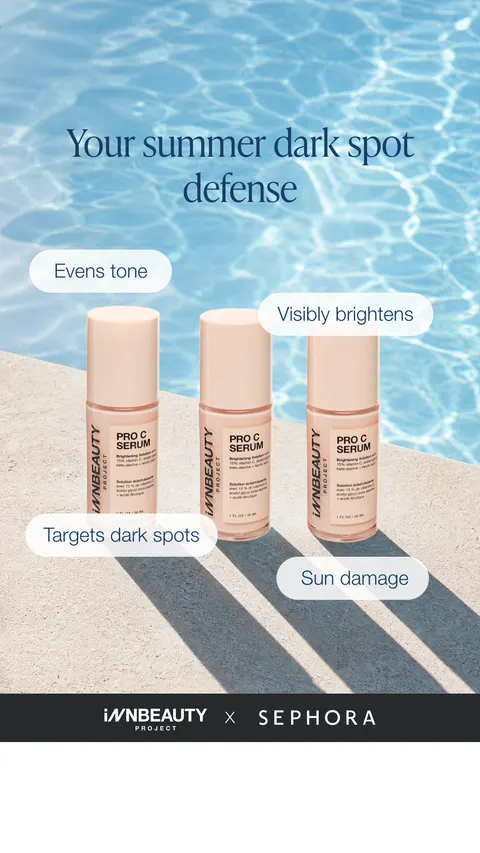
Benefit callouts around 3 products
INNBeauty arranges 3 products against a poolside setting, with small benefit labels pointing toward the products. The headline sits above the group and the retail line below it.
What to look for: Which callout can be understood from the image, and which depends on product evidence outside the ad?
Try this: Give each callout an approved product fact. Check the finished ad on your phone so the labels are readable without covering the product.
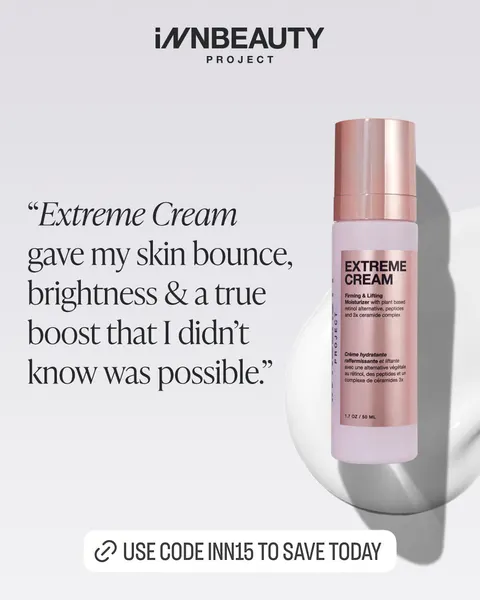
A quote, a product and an offer
The product sits beside a multi-line first-person quote, with a separate offer strip below. The quote describes an experience, while the image shows the product.
What to look for: Would your brief use a customer experience or a direct product explanation as the lead message?
Try this: Compare the 2 approaches without treating a quote as efficacy evidence. The testimonial collection examines attribution and quote length in more detail.
These skincare ads lead with different things: the product, the person using it, a benefit or a quote. Look at which one gets your attention and what else you’d need to see. The ads alone don’t tell us whether the product or campaign worked.
Separate a skin care ad claim from its visible demonstration
Skincare advertising can lead with the product, a person, a stated benefit or a quote. These skin care ad examples let you compare those choices. Seeing a product in someone’s hand does not verify the speaker’s experience, ingredients or a clinical outcome.
- Record what is visible: product, application, person or written statement. Attribute a benefit to the advertiser when it is copy rather than evidence established by the preview.
- For a demonstration, state the exact step your own footage must show and the facts the product owner must confirm. Do not turn a texture or application shot into a claim of effectiveness.
- For creator-style delivery or a testimonial, check the relationship, complete message and usage separately. Use the focused UGC worksheet when those unknowns are the main research question.
What to look for in this collection
Describe the visible product relationship
Is the person showing the product or showing how to use it? A close-up helps people recognize it. An application shot needs to make the actual step clear.
Map the claim to the image
Read the benefit, then look at the image. Does it show the product, the texture or how to apply it? Use the layout as a reference, and check the claim separately.
Choose one job for the next creative
Choose 1 thing for the ad to explain, such as how to apply the product. Give the creator the approved instructions and any product facts they’ll need.
Turn the references into a decision
Write one observation, one hypothesis and one production choice. Keep the reference beside each note so your team can see how you got there.
Research your own collection in Barry
Starter opens 1 brand on the Infinity Board. Pro adds search by look, saved boards and sharing. The board is designed for a desktop browser. These examples and worksheets work on your phone too.
Continue with another research question
Testimonial ad examples: compare the quote and the product
See how quote-led ads balance a statement and the product. Compare the layouts, check who the quote comes from and plan your own testimonial ad.
Clothing ad examples: outfit, detail, collage and quote
Compare clothing ad examples by outfit, fabric detail, collage and quote. See what each view shows before planning your own shoot.
Planning notes: Match the picture to the evidence
Match the picture to the evidence
This selected sample uses existing Barry previews reviewed October 12, 2026, including limited silent snippets. It is not a complete platform archive or a market census.
- Product view
- Shows the product shape and label position. Check readability in our real export.
- Application view
- Shows an approved action with our own product. Confirm directions and capture continuity.
- Claim review
- Benefit, timeline and experience statements need their own support before use.