Perfume ad examples: make fragrance visible
People can't smell the fragrance through the ad. Look at how the product is shown and what helps someone decide whether it's for them.
2 PHLUR frames, 2 different opening jobs
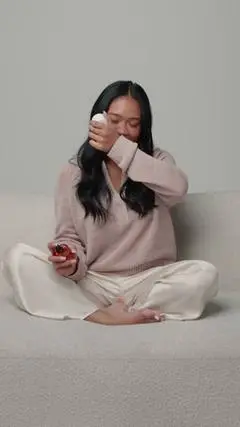
Connect the product to a recognisable use gesture
The PHLUR still shows a seated person holding the product with their wrist near their face. Notice how the product stays visible during the gesture. The image can't tell us the scent notes or lasting power.
What to look for: Does the product remain recognisable while the person uses it?
Try this: Plan an unobstructed product view and a real use gesture with your own sample.
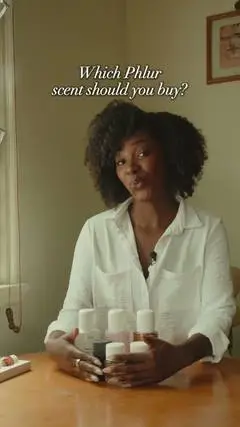
Start with the scent-choice question
PHLUR asks “Which Phlur scent should you buy?” above a person and several products. The question gives the comparison a clear starting point. The still doesn't show the advice that follows.
What to look for: What specific choice can your product facts help someone make?
Try this: Build the comparison around approved descriptions and a useful sampling or product destination.
A perfume ad has to introduce something the viewer cannot smell. We look at the visible choices that help: a clear product view, a useful scent question, a person using the product and a setting that suits the fragrance.
What a perfume ad needs to explain
Start with the decision your viewer is making. Someone discovering a fragrance needs a way to imagine it. Someone choosing between scents needs a distinction. Someone buying a gift needs help choosing a format and understanding what arrives. These are different assignments, even when the product and background stay the same.
A mood can invite attention, but it cannot supply every product fact. Write the customer question at the top of your brief, then decide which part the creative can answer visually and which part belongs in the copy or destination. Our 2 retained PHLUR frames are useful contrasts: one centers a personal gesture. The other explicitly asks which scent to choose.
Read the person and product separately
The seated PHLUR image puts the product beside a person bringing their wrist toward their face. The product stays part of the action. For your shoot, keep the item and the gesture easy to follow. This still doesn't tell us what she says or how the fragrance smells.
For your own shoot, list the exact action before naming the mood. Holding a bottle, removing a cap, applying a spray and smelling a wrist need different shots. If application matters to the message, capture the action clearly rather than relying on the viewer to infer it from a reaction. Keep the label and hand movement visible long enough to understand.
Turn a scent-choice question into a useful comparison
The second PHLUR image asks which scent to buy, with several products on the table. That gives the ad a clear question to answer. Use a specific choice like this to plan your own comparison. We would need the full source to know what advice follows in this ad.
In an original comparison, choose a dimension the product owner can support. It might be the brand's published fragrance family, the formats in a discovery set or the occasions the brand proposes. Keep preference language separate from objective facts. A suggestion for an evening scent is different from a promise that everyone will prefer it or that it lasts a specific number of hours.
Build a sensory world with deliberate visual choices
Turn the mood into shots the team can make. That could be a softly lit dressing table, fabric moving beside a sleeve or a clear view of the sample set. Name the light, setting and action instead of leaving the brief at a word like sensual.
Avoid making props do the work of a product specification. A cedar branch in a set is an art-direction choice. It is not independent evidence that the perfume contains cedar. Check the brand's approved product description before writing a note, ingredient or concentration into the ad. A bottle's appearance also does not establish its size or the contents of a purchase.
An original discovery-set concept
Our brief is for a fragrance discovery set with 3 samples. For this exercise, we have invented a set with 3 labeled samples and a card naming each one. The opening shows the set with the question, 'Which one feels like your evening?' The body presents one vial at a time beside a clearly different visual setting. The close returns to all 3 samples and invites the viewer to see what is included.
For each part of the video, write down what the viewer should be able to identify. The opening identifies the set. The body keeps the same vial label visible as its setting changes. The close shows every included item together. Before adapting this exercise to a real product, replace the assumptions with verified sample sizes, contents and brand-approved scent descriptions. These are original planning choices, not PHLUR's script or an observed campaign result.
Compare concepts before making more versions
A person-led scent-choice guide and a still-life product reveal are different concepts because they explain the purchase differently. Changing the color of the background within either idea is an execution variation. Put the central explanation in one sentence before comparing crops, captions or music.
We would keep the product and destination consistent when asking which explanation people understand more clearly. Review the actual responses or campaign evidence separately from the reference. The number of variations you find, how attractive an image looks or how long it appears in a library does not establish that it sold more perfume.
Take a specific assignment back to production
Finish with a reference, the choice you observed and the decision you want your team to make. 'Use this perfume ad' leaves too much unsaid. 'Open with 3 clearly labeled samples and a scent-choice question, then show the set contents before the CTA' is a production assignment.
Put the scent question, reference, planned shots and product facts in the worksheet. Name anything the product team still needs to confirm. Give the writer and producer a clear idea to make with your products, rather than asking them to copy the reference.
Use the worksheet
The completed example separates what we can see in the ads from our own plan. Use the blank worksheet for your product details, supporting sources and the people reviewing the work.
Start with the blank worksheet, or read the filled-in example to see how to use it. You can copy either one.