Ad campaign examples: find the message across executions
Look for the idea that connects the ads. Then separate the parts that stay the same from the parts that change between versions.
Establish what belongs to the case
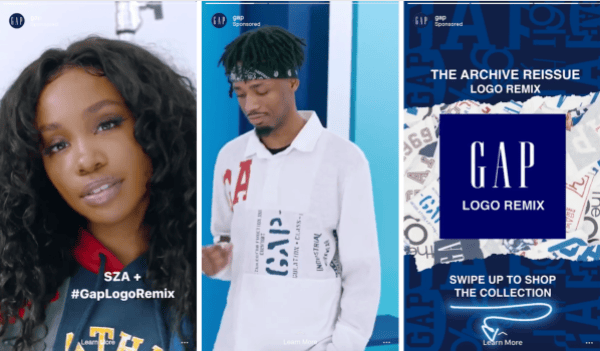
A portrait, a product and a shopping action
Meta’s 2018 illustration puts 3 panels side by side: SZA with Logo Remix text, someone wearing a Gap shirt and a closing panel with shopping copy. We can follow that message order, but this image doesn’t show the original timing.
What to look for: What new information does each panel introduce?
Try this: Assign a separate job to the opening, product view and action. Keep your own message and destination consistent.
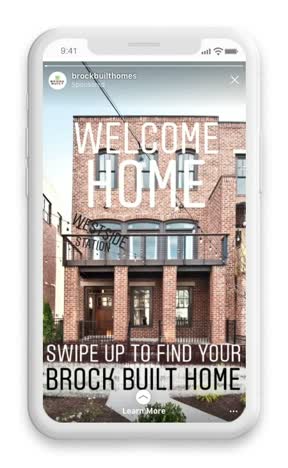
A home message stays inside the phone frame
The producer’s montage shows home exteriors, interior details, short lines of text and a swipe action inside the phone frame. The source identifies it as a Stories project, but doesn’t show where every original ad starts and ends.
What to look for: Which product detail must remain understandable in a full-screen composition?
Try this: Shoot your own whole product view and detail view. Review text against the platform interface before export.
Compare 3 famous advertising campaigns through their documented ideas, then study 2 illustrated placement cases. Use the differences to plan the message and job of each piece in your own campaign.
Establish what belongs to the case
Meta’s 2018 announcement names Gap among the initial Stories-carousel partners and supplies the Logo Remix illustration. Rearview’s Brock Built case documents a Stories project with 2 single and 2 carousel units. These sources establish project context. The producer montage does not recover every original unit, and unrelated library references are not promoted to the same campaign.
Compare the repeated message with new information
Gap moves from the collection to the product and shopping action. Brock Built keeps the homes and invitation together inside the phone frame. Look for the idea that stays consistent and what each new view adds. The number of versions won’t tell us who was targeted, what was spent or how the campaign performed.
A campaign plan does not tell us how it performed
Nike’s official Winning Isn’t for Everyone record describes campaign launch and later extensions. That source establishes the launch and later additions. We would still need to review each film or poster before analyzing it. A famous campaign is not a profitability ranking. Attribute any published result to its source and method. None is adopted here.
An original campaign with 3 execution jobs
For the pouch, make one open-layout image to inspect arrangement, one continuous-access video to explain retrieval and one 3-card plan to stage the information. Repeat the same fixed product and props. Give each execution a separate question, then connect the action to the same mock layout content. These are planned original executions, not a real campaign.
Carry decisions into production and learning
Write the shared message, then give each version a job. Keep the product and offer consistent while the shots change. Review the final files together, and record delivery and results separately once the campaign runs.
Famous advertising campaigns: compare the idea before the ranking
If you are looking for the best ad of all time, first choose what you want to learn from it. A memorable line, a clear product demonstration and a campaign that carries across many executions are different creative achievements. Our selection below compares 3 documented campaigns by those jobs. It is an editorial study, not an all-time ranking, a popularity survey or a claim that one campaign sold more than another.
The brands’ own histories establish the names and context. We use them to ask what our own brief would need to specify. A brand describing its work as iconic is not independent proof of superiority. The source links let you inspect the original material. The 2 illustrated placement cases above remain separate examples, with their existing source limits.
Coca-Cola Hilltop: connect the product to a shared situation
Coca-Cola dates Hilltop to 1971 and describes a group singing together on an Italian hillside. Its history also explains the production and later digital reinterpretation. The useful creative question is how a social situation gives the product a role. That is a different starting point from listing product features. The brand’s account supplies the history, not a verified return on advertising spend.
For an original picnic-product brief, identify what people do together and when your own product enters that action. Ask the producer for a whole scene and the product interaction that connects to it. Do not borrow the song, cast or famous setting. Review whether the product has a clear role in your scene before adding a broad emotional promise.
Nike Just Do It: keep a central idea while changing the execution
Nike’s September 4, 2025 announcement dates Just Do It to 1988 and introduces Why Do It? as a new campaign. It identifies Walt Stack’s running ad in its account of the earlier work. That gives us a documented example of a continuing brand idea with a different contemporary expression. The announcement describes the intent. It does not establish how either campaign performed.
For your own brief, write the belief you want to keep and the specific question this execution asks. A running-club brief might keep the idea of beginning and focus on arriving for a first session. The producer needs the real meeting place, participant permission and an action the footage can show. A new heading alone is not a new concept if the footage and explanation do the same job.
Apple Shot on iPhone: make the output part of the evidence
Apple’s February 26, 2019 announcement presents 10 selected photographs from its Shot on iPhone Challenge and says they will appear on billboards, in stores and online. Each entry identifies the photographer and phone model. The collection demonstrates a way to make the product’s output the creative material, with attribution attached. It does not show that every user will get the same result or establish a sales lift.
For an original campaign built around what the product makes, record who made each example, which product was used and what editing or production context a viewer needs. Decide which detail must remain visible in a small ad and which needs a closer view on the destination. Use your own licensed material and accurate attribution. Choose varied examples that explain a useful difference rather than repeating the same attractive result.
Choose the campaign reference by the job in your brief
Use Hilltop to discuss a shared situation, Nike to discuss continuity of an idea and Shot on iPhone to discuss visible output with attribution. Then compare the Gap and Brock examples above for message order inside a placement. These are different research questions. Calling all of them successful would hide the decision you need to make and imply results we have not checked.
For a cafe brief, define 1 promise: show what pickup lunch includes. A complete-meal image answers the contents question, a short counter sequence explains collection and the destination confirms branch and availability. Keep the same verified meal details across all 3. Record the file, job, destination and review owner in the campaign worksheet below. This is an original plan, not a campaign we have launched or a prediction of results.
Use the worksheet
The completed example separates what we can see in the ads from our own plan. Use the blank worksheet for your product details, supporting sources and the people reviewing the work.
Start with the blank worksheet, or read the filled-in example to see how to use it. You can copy either one.